
Evidence in motion.
Innovation with purpose.
We bring sport science, human performance research, technological thinking and inclusive innovation together—connecting what we can measure with what people can actually experience.
From scientific insight to practical impact.
An independent innovation company with academic roots and a European perspective.
SPORTEK Sports Technology Research and Education Limited Company was founded on 6 October 2024 and operates within the Kahramanmaraş Teknokent innovation ecosystem in Türkiye.
Our purpose is to build bridges between sport sciences, education, interdisciplinary R&D, technology, inclusive participation and European cooperation. We explore how scientific assessment and evidence-informed approaches can support athlete development, healthier and more active lifestyles, and more accessible sport opportunities.
SPORTEK operates as an independent company. Our team brings experience from academic research and Erasmus+ activities at Kahramanmaraş Sütçü İmam University (KSU), while the company's own projects and responsibilities remain institutionally distinct.
Our vision reaches beyond any single test or discipline: to translate evidence into methods, educational resources and partnerships that people and organisations can use.
Understand performance.
Move beyond assumptions.
From cardiorespiratory response and sprint timing to motion analysis and short-duration power, sport science methods help researchers ask more precise questions. The examples below illustrate established assessment approaches.
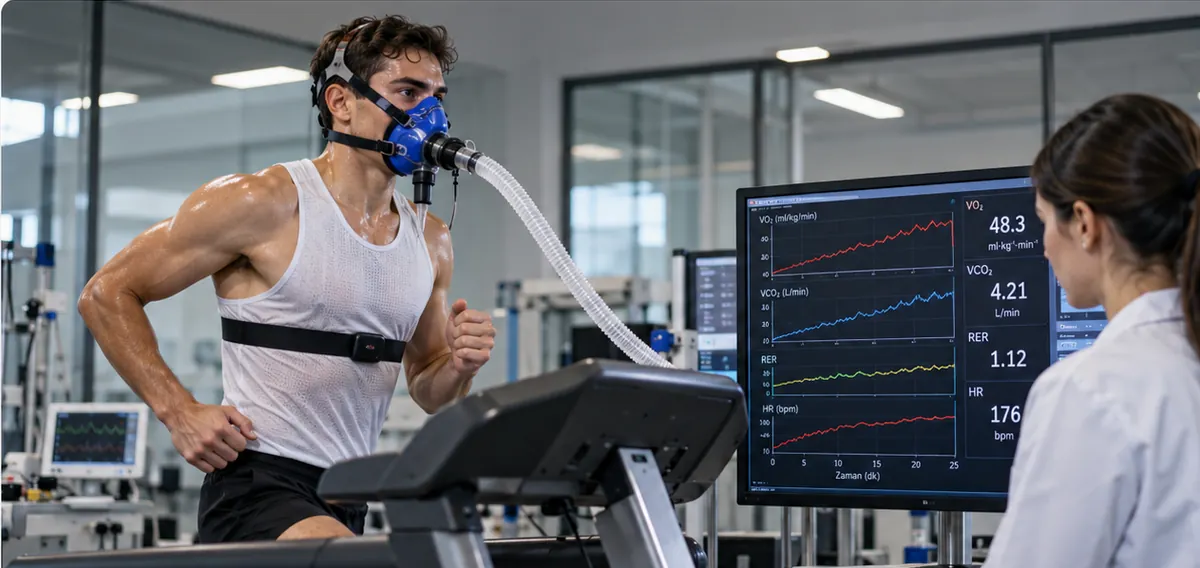
Aerobic physiologyVO₂max & Cardiorespiratory Testing
A progressive treadmill or cycle-ergometer protocol examines oxygen uptake and physiological responses as exercise intensity increases. It supports the assessment of aerobic capacity and endurance-related adaptation.
 Speed & acceleration
Sprint & Acceleration Testing
Short sprints, often measured with timing gates, help examine acceleration and speed performance over defined distances. Repeated-sprint protocols can provide additional insight into the ability to sustain high-intensity efforts.
 Movement analysis
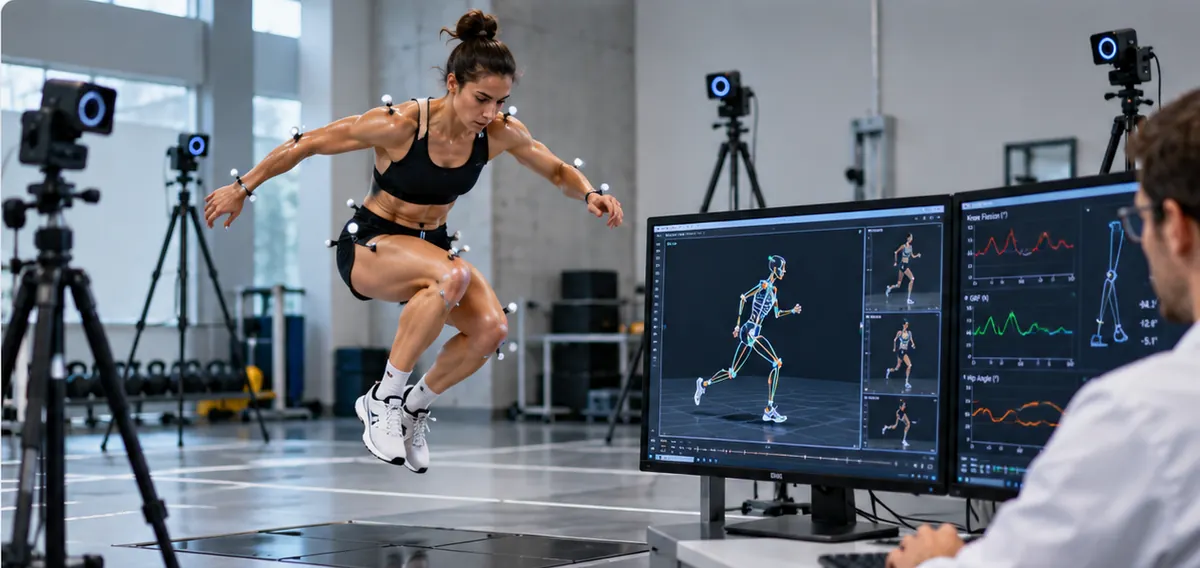
Biomechanics & Motion Analysis
Video analysis, motion capture and, when available, force measurement technologies can be used to examine movement technique and mechanical demands. Findings can inform technique refinement and research into movement efficiency.
 Anaerobic performance
Wingate Anaerobic Test
A 30-second maximal cycling effort on a suitable ergometer is commonly used to evaluate short-duration anaerobic performance. Protocol-specific outputs include peak and mean power, and indices describing power decline.
Visual note: The four images are AI-generated illustrative depictions of sports science methods, not documentary photographs of SPORTEK staff, laboratories or equipment. The descriptions explain established methods and do not claim that every test is presently offered by SPORTEK; equipment and protocols depend on the specific research partnership and setting.
Research priorities that connect people, performance and innovation.
Our work is shaped by interdisciplinary questions, field realities and the practical value of evidence.
Human performance & exercise science
Applied assessment methods, training-response interpretation and research-informed approaches to physical performance.
Sports technology & data
Exploring measurement systems, data-informed decision making and useful digital tools for sport environments.
Inclusive & adaptive physical activity
Research and intervention concepts that address barriers to participation for persons with disabilities and underserved groups.
Coach education & capacity building
Evidence-based learning formats that connect scientific knowledge with coaches, educators, practitioners and clubs.
Active lifestyles & well-being
Movement-based approaches that support regular participation, lifelong activity and community well-being.
Nature-based sport & sustainability
Connecting physical activity, environmental awareness and responsible innovation in outdoor and community settings.
From the right question to a result that matters.
We view R&D as a collaborative pathway, not an isolated laboratory exercise.
Identify
Define a real-world need with athletes, coaches, institutions or communities.
Design
Develop appropriate research questions, measures, protocols and safeguards.
Measure
Gather meaningful data through suitable scientific and field-based methods.
Interpret
Evaluate results carefully and translate findings into practical recommendations.
Transfer
Share knowledge through learning, innovation, partnerships and dissemination.
Projects that move ideas into society.
Our portfolio combines new initiatives under SPORTEK's independent identity with relevant academic experience brought by our team.

BeNATURE
Supporting development, inclusion and active participation through nature-based play and movement opportunities for children with ADHD.
Explore BeNATURE ↗
Green4Canoeing
Bringing together inclusive canoeing, active participation and environmental awareness through sport-centred cooperation.
Explore Green4Canoeing ↗Hear2Move: Accessible Physical Activity
Hear2Move explores an accessible route from adapted exercise research and participant feedback to audio-guided physical activity for people with visual impairments. Its planned research pathway brings together exercise adaptation, inclusive design, digital development and user evaluation.
University-led initiative coordinated by Kahramanmaraş Sütçü İmam University (KSU). Presented as academic project experience, not as a project contracted under SPORTEK.
Explore Hear2Move
Accessible sport / Audio-guided exercise
Experience gained through university-led European sport projects
Members of the SPORTEK team bring experience from Erasmus+ sport initiatives conducted within Kahramanmaraş Sütçü İmam University (KSU). This background includes work on gender equality in sport, active ageing, inclusive family sport, adapted darts for visually impaired people and inclusive hockey.
Institutional transparency: SWoST, KATSURA, Train4Family, Darts4Blind and Hockey4All are presented as prior university-based experience of SPORTEK team members, not as projects contracted or implemented under SPORTEK's company identity.
A multidisciplinary team. A common purpose.
Scientific expertise and practical field knowledge come together through researchers, project specialists and sport practitioners.
Prof. Dr. Ökkeş Alpaslan Gençay
Sport Scientist · Project Manager
Prof. Dr. Selçuk Gençay
Sport Scientist · Project Researcher
Doç. Dr. Cihat Korkmaz
Sport Scientist · Project Researcher
Let's turn research questions into meaningful progress.
We welcome conversations with universities, sport organisations, clubs, public institutions and European partners interested in rigorous, inclusive and practice-oriented R&D.